Offerings: the language of remembrance
An offering is not a collection of objects arranged for strangers to see. It is a way of welcoming someone. In a house, chapel or beside a grave, food, flowers and light speak of a particular person: what they ate, the relationships they built and the place they still hold among their loved ones. Around Lake Pátzcuaro, this family gesture lies at the heart of the Festival of Souls.
The table that waits
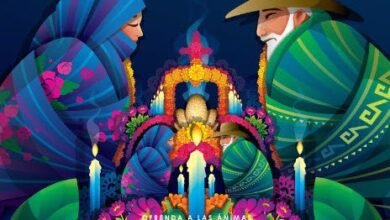
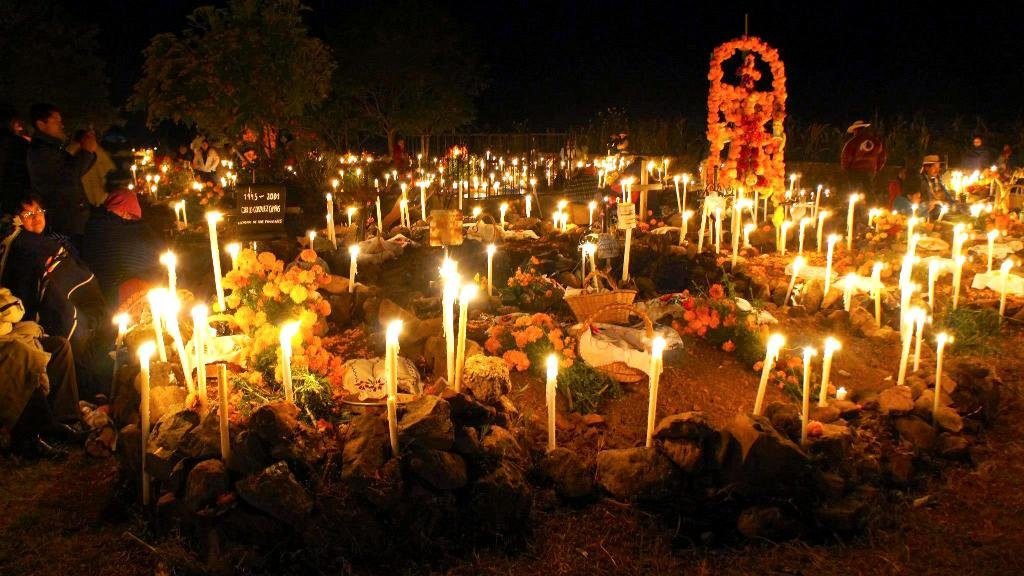
Water, bread, seasonal fruit and dishes prepared for the dead person express hospitality toward someone who returns in the family’s remembrance. Candles accompany the waiting; many households use copal incense. In some places, yellow flower petals mark the path toward the altar. Mexico’s National Institute of Indigenous Peoples (INPI) documents the meanings of these elements and, especially, their role as an encounter between the living and the absent.
There is no compulsory inventory, however, nor one altar design prescribed for the whole region. Dimensions, foods, religious images and ways of bringing relatives together differ between communities and even between houses. The name of an artisanal object does not establish that it carries precisely the same ritual meaning everywhere.
The floral arch and the first offering
The flower-covered arch becomes especially important when remembering someone who died recently. In Jarácuaro, an INPI account explains that baptismal godparents take part in the novena and bring an arch made of reed and decorated with flowers. Following prayers and a shared meal, the arch is taken to the cemetery. This connection between godparenthood, collective work, hospitality and mourning reveals more than any list of decorative items: an offering binds together a network of people.
Documentation published by Michoacán’s Secretariat of Culture in October 2026 describes another expression of the same principle in Santa Fe de la Laguna. Tradition bearers Guadalupe Hernández Dimas and Ireri Gabriela Huacuz Dimas explain the uatsarhukua, a decorated wooden structure from which bread, fruit and sugar figures hang; before it stand elements such as the cross, water, salt, candles and copal. This account belongs to a specific community. It must not become a formula imposed on all others.
When objects hold a life story
A photograph may identify the person remembered. An item of clothing, a tool or a favourite dish may recall something of their everyday life. Offerings also speak at times of migration, separated families and bonds that endure across distances. Their contents change from generation to generation: memory does not have to stand still to remain meaningful.
UNESCO recognizes the Indigenous festivities dedicated to the dead in Mexico, first proclaimed in 2003 and inscribed in 2008, as a cultural expression rooted in many communities across the country. The recognition is not exclusive to Pátzcuaro. The lake basin nevertheless offers distinctive traditions and relations with the dead that deserve to be understood on their own terms.
The visitor’s place
An offering is not made to be consumed by a camera, nor does it oblige a family to welcome outsiders. Visitors can learn a great deal by observing discreetly, accepting family boundaries and asking before photographing. A personal invitation should be received as a gesture, never as a service purchased.
At its core, an offering brings together work, food, remembrance and affection. Its beauty comes from those relationships, not from the number of flowers or the size of the arch.
Documentary sources (original titles)
- UNESCO, «Las fiestas indígenas dedicadas a los muertos», expediente 00054; proclamación de 2003 e inscripción de 2008.
- Instituto Nacional de los Pueblos Indígenas, «¿Conoces el significado de los elementos de una ofrenda de Día de Muertos?», 23 de octubre de 2019.
- Instituto Nacional de los Pueblos Indígenas, «11 altares indígenas de Día de Muertos», sección Jarácuaro.
- Secretaría de Cultura de Michoacán, «Secum acercará el simbolismo de la ofrenda purépecha al Museo del Estado», 27 de octubre de 2026; información de portadoras de tradición de Santa Fe de la Laguna.
Original Spanish titles and publication details are retained in the bibliography for accurate source identification.