Tócuaro: masks that hold other faces
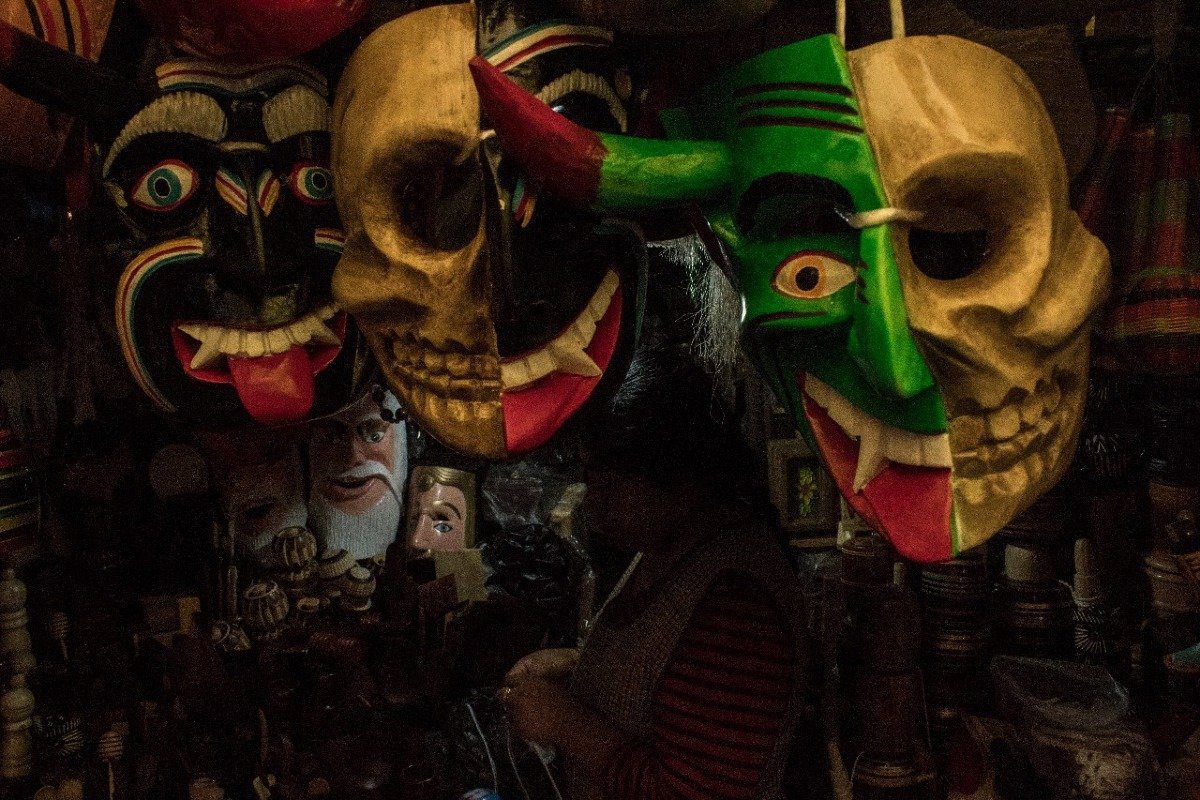
A mask seems to conceal the person wearing it, but it also allows someone else to appear. In Tócuaro, a community within the municipality of Erongarícuaro, wood is carved to bring characters from dances, pastorelas and other celebrations onto the stage. These are not interchangeable figures. Each face belongs to a dramatic story, a family of techniques and often a calendar different from that of the Festival of Souls.
Visitors arriving in November should avoid a common confusion. The prominence of masks in regional folk art does not mean that every mask is used in vigils for the dead. The connection may be artisanal, educational or part of an exhibition; we should not invent a funerary rite that the sources do not describe.
A face carved from a single piece of wood
Mexico’s Cultural Information System describes a carving process that begins by choosing wood, continues through broad cuts and proceeds toward expressive details. Its account names woods such as copalillo, avocado and jacaranda, and notes family participation in smoothing and finishing pieces. The craft requires understanding the character of the mask before painting it.
Eyebrows, mouths, exaggerated grimaces and fantastic animals help make characters recognizable. The same official record lists devils, satirical figures and pastorela performers among a wider repertoire of dance characters. Some faces are made to frighten; others to make people laugh or dramatize a moral conflict. A mask gains meaning through the performance in which it is used.
Devils are not confined to November
Official documentation places much of Tócuaro’s mask-making within pastorelas and celebrations associated with Candlemas. This distinction matters: a pastorela must not automatically be described as a Festival of Souls ceremony. Fairs, workshops and displays may bring different expressions together during one season without erasing their distinct histories.
A federal Ministry of Culture profile published in December 2024 tells the story of Felipe de Jesús Horta Tera, who learned carving as a child and has devoted decades to making masks. Naming a master gives an individual career its due; it does not make his life the biography of an entire community or allow every mask seen in a shop to be attributed to him.
Craft, imagination and markets
Masks circulate among community festivals, competitions, collections and galleries. These paths are not necessarily opposed. A work can preserve the memory of a character while reaching new audiences. The difficulty arises when an object is sold without naming its maker, or tourist storytelling reduces Tócuaro to a collection of anonymous masks.
In 2026, the Michoacán government included Tócuaro among places associated with cultural workshops during the Day of the Dead celebration week, announced for October 23–31. This was a dated 2026 tourist programme, not the annual schedule of a dance or evidence that the same workshops occur every year.
Learning to look respectfully
Visitors can ask about materials, the character a mask represents and the workshop that produced it. Such a conversation is more valuable than claiming, without evidence, that a pastorela devil guides the dead or that every carved face belongs to cemetery vigils.
UNESCO recognizes Indigenous festivities dedicated to the dead in Mexico within a broader framework of cultural heritage. It has not individually inscribed the masks of Tócuaro. Here, heritage also lies in family training, the continuity of performance and the creative freedom of those who carve wood.
A mask completes its journey when someone looks at it and realizes that the carved face is not the whole story. Behind it are the artisan’s hands and, behind those hands, a community with much more to tell.
Editorial note: Historic craft traditions and the announced workshops for 2026 remain separate. There have been no new interviews or real-time checks of community access.
Documentary sources (original titles)
- Sistema de Información Cultural, Secretaría de Cultura. Máscaras ceremoniales de Tocuaro. Registro técnico de maderas, técnicas, personajes y usos de las máscaras. Tipo: registro institucional.
- Secretaría de Cultura federal. Felipe de Jesús Horta y sus máscaras de Tócuaro, un legado vivo en madera. 3 de diciembre de 2024; oficio, aprendizaje familiar y pastorelas. Tipo: semblanza institucional.
- Gobierno de Michoacán. Comunidades purépechas compartirán sus saberes ancestrales de Noche de Muertos. 30 de septiembre de 2026; programa de talleres 2026. Tipo: anuncio de talleres 2026 / archivo.
- Gobierno de Michoacán. Vive las tradiciones de Noche de Muertos con los talleres artesanales. 22 de octubre de 2026; talleres del 23 al 31 de octubre. Tipo: aviso institucional 2026 / archivo.
- UNESCO. Las fiestas indígenas dedicadas a los muertos (expediente 00054). Marco general: no inscribe individualmente a Tócuaro ni a sus máscaras. Tipo: registro patrimonial.
Original Spanish titles and publication details are retained in the bibliography for accurate source identification.