Yunuén: an island told by its own inhabitants
The lake separates and connects. From the shore, Yunuén may look like little more than a patch of green surrounded by water; on the island, the landscape is shaped by different names, journeys and memories. This is the first distinction between looking at a destination and listening to a community: visitors see a horizon, while the people who live there recognize stories.
There is no need to invent a secret ceremony to make Yunuén worth understanding. The National Laboratory of Oral Materials at the National Autonomous University of Mexico (LANMO-UNAM) brought together conversations with islanders in the book El rey que se ahogó. Relatos de Yunuén (The King Who Drowned: Stories from Yunuén), published in 2019. The book’s importance lies not in establishing one definitive legend, but in preserving versions that coexist and change in the memories of the people who tell them.
A name need not have just one story
Among the accounts edited by LANMO is that of a woman who recalls a story about a drowned king and a shape resembling a bent arm. In the same account she notes that other people say “half moon.” These explanations belong to recorded oral tradition. They are not equivalent linguistic proofs, and neither establishes the name’s etymology.
An island can hold several accounts of its name without an editor arbitrarily choosing one. Acknowledging that plurality is more respectful than offering visitors a single translation and repeating it until it seems unquestionable.
Words have a territory of their own
LANMO’s lake-region repository documents interviews, songs, stories and local memory using recording and transcription methods. A record of an interview conducted on Yunuén in June 2013 identifies Juan Benjamín Antonio Asencio and Laura Campos as participants and lists places around the lake, characters in stories, religious celebrations and the cemetery among its topics. The record establishes only that these subjects were discussed: without the full transcript, it cannot tell us exactly what was said about the Day of the Dead.
The book and repository bring a simple truth into focus: a community’s story does not begin when someone arrives to photograph it. Islanders’ memories are part of the knowledge of the landscape, as much as its houses, paths and ways of making a living around the water.
The architecture of island life
In an academic study, Ana Emma Zavala Loaiza and Catherine Ettinger examined the settlement patterns of Yunuén, La Pacanda and Jarácuaro, considering their lakeside landscapes and residents’ perceptions. Rather than empty backdrops, the islands emerge as built and inhabited places. The apparent stillness of the water does not mean that daily needs, journeys and work disappear.
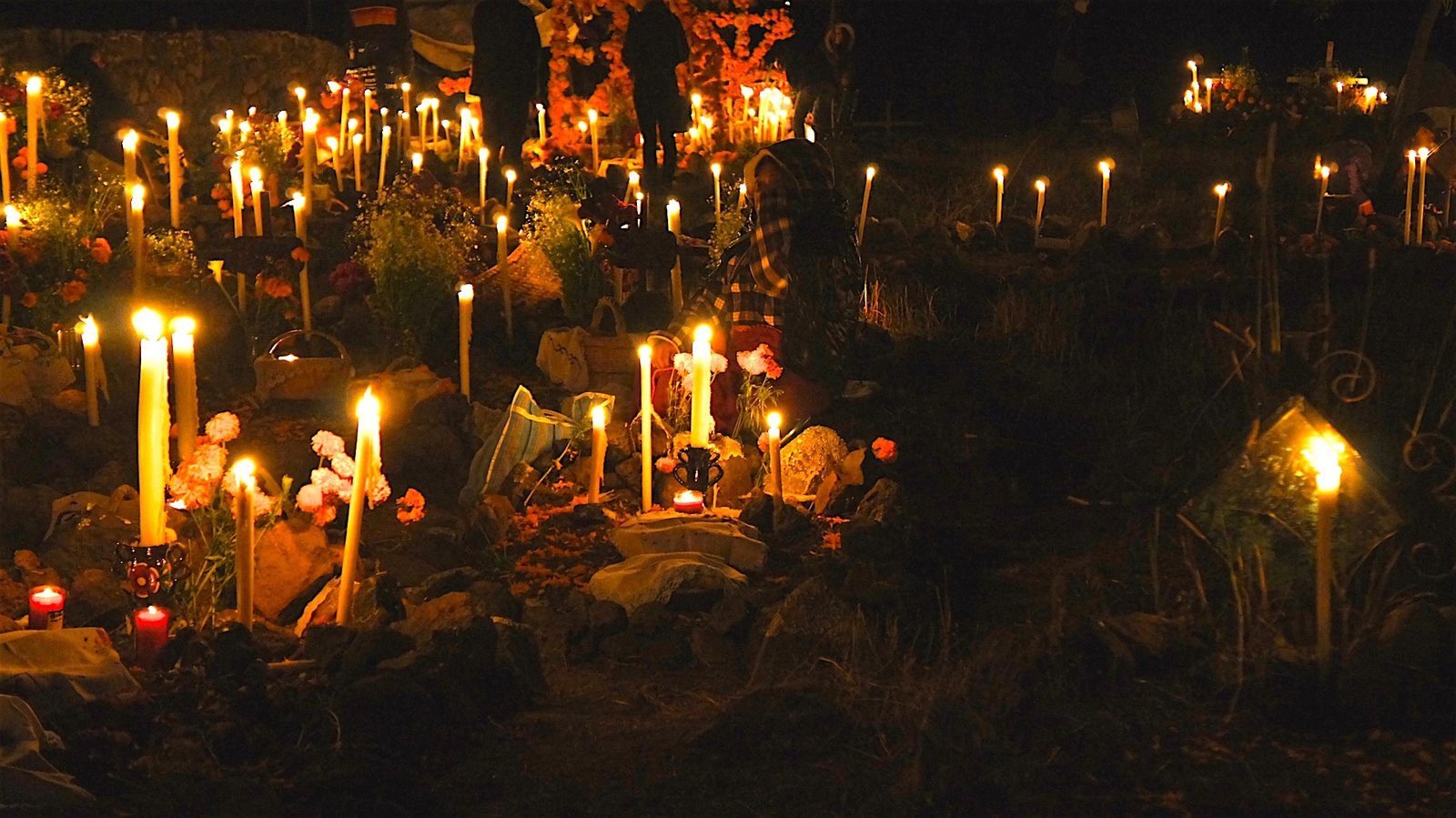
This offers one way to approach the season of the souls. Commemoration has meaning within family and community relationships. It is not a product to which a boat ticket automatically grants access. Practices may vary between islands, homes and years, and the available public record does not substantiate any Day of the Dead ceremony exclusive to Yunuén for 2026.
What we do not know also belongs in an honest account
The microsite’s earlier article described a ceremony called the “drowning and resurfacing of mezcal” as a hallmark of the island and attributed a particular version of the Hapunda legend to Yunuén. Sufficient documentary support for those local attributions has not been established, nor for presenting them as recurring community ceremonies. They are therefore not repeated here as facts or attractions available to visitors.
Nor do we promise accommodation, ritual demonstrations, entry into homes or nighttime crossings without up-to-date confirmation from local residents or operators. UNESCO recognizes the Indigenous festivity dedicated to the dead in Mexico in its broader cultural context; that recognition is not an inventory of mandatory attractions on every island.
Memory needs no spectacle
Perhaps Yunuén’s most important lesson is that one can listen without demanding a single story. Oral accounts are neither travel instructions nor unmediated records of a distant past. They are situated voices, recorded in particular years, with the richness and limitations inherent in testimony.
As darkness falls over the lake, the island remains someone’s home. To look at it respectfully is to resist filling it with invented rituals and to let the words of its inhabitants follow their own course.
Sources and attribution notes
- Santiago Cortés and Berenice Granados (eds.), LANMO-UNAM. El rey que se ahogó. Relatos de Yunuén. 2019 edition; islanders’ narratives, including different explanations of the name. Academic research and oral tradition.
- LANMO-UNAM. Lake Region of Michoacán Repository. Oral documentation methods since 2013; distinguishes narratives from historical facts. Academic methodology.
- LANMO-UNAM. Interview record: Juan Benjamín Antonio Asencio and Laura Campos. Recorded June 20, 2013, on Yunuén; mentions religious celebrations and a cemetery. Oral testimony record; not a complete transcript.
- Ana Emma Zavala Loaiza and Catherine Ettinger. Study of settlement morphology and social perceptions on Yunuén, Pacanda and Jarácuaro. Academic study, 2023. Territorial research.
- UNESCO. Indigenous festivity dedicated to the dead in Mexico, file 00054. General framework; does not establish an exclusive ritual on Yunuén. Heritage reference.
Editorial note: Oral accounts are situated testimonies, not direct reconstructions of the distant past. Tourism announcements from 2026 cannot substantiate future events or access. No new interviews, site visits or WordPress changes were carried out.