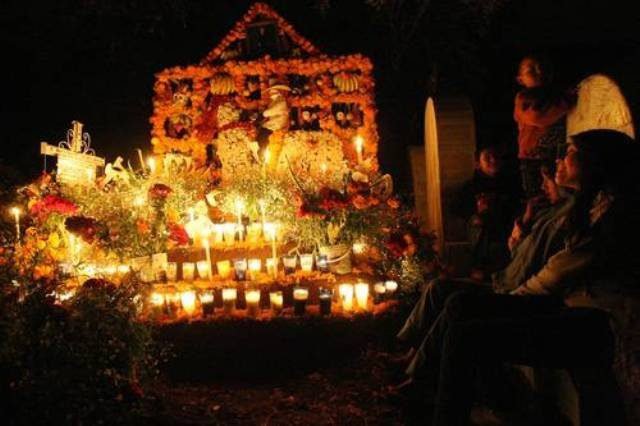
Tzintzuntzan: yácatas, floral arches and shared remembrance
Tzintzuntzan brings together two historical landscapes that should be understood without merging them. One belongs to the ancient Purépecha political world: the yácatas and archaeological remains testify to a major seat of power in Michoacán. The other lives in churches, homes and cemeteries where families continue to honour their dead. Centuries of change lie between them, and those transformations are part of the town’s memory.
A town with a long history
The National Institute of Anthropology and History (INAH) preserves and interprets the Tzintzuntzan archaeological site as an essential part of Purépecha heritage. Nearby, the former Franciscan Convent of Santa Ana represents a different chapter of the region’s past. Its complex and Olive Tree Atrium are important cultural places, but it would be misleading to suggest that every November ceremony occurs there.
The pre-Hispanic past gives depth to a visit. It does not make every present-day funerary custom an exact repetition of a ritual practised before the Spanish conquest. Today’s altars have family, religious and community histories of their own.
Offerings and the work of families
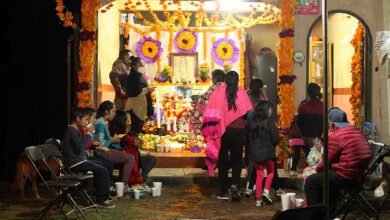
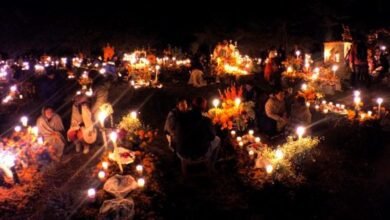
During the Festival of Souls, flowers, candles, food and personal belongings may accompany remembrance of those who have died. This work begins before the vigil: relatives and neighbours clean graves, arrange meals and agree on how to gather.
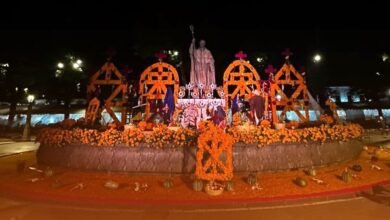
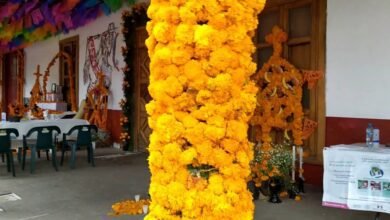
Cultural documents and official announcements from different years also describe floral arches and regional crafts. Yet we should avoid presenting one procession as if it always departed at a fixed hour and followed the same route. Public programmes change and must be checked for the year concerned.
A cemetery is not a stage
A 2013 study by Gabriela Servín Orduño and Cindy Vanessa Olvera Camacho examined the cemeteries of Tzintzuntzan, Cucuchucho and Arócutin through cultural geography. Their research remains useful because it sees these places as meeting points of architecture, community life, remembrance, history and social relationships—not simply atmospheric night scenes for photographs.
Alongside family ceremonies, Tzintzuntzan also has crafts and cultural activities open to visitors. These may complement one another, but they are not the same practice. Someone approaching a cemetery must first recognize that they are observing from outside a family’s moment of remembrance.
Floral arches and candles draw the eye; the celebration’s deeper strength lies in the people who prepare offerings and return to remember their dead. Tzintzuntzan deserves to be told through that depth, not through a promised spectacle supposedly repeated unchanged every November.
Documentary sources (original titles)
- INAH, Zona Arqueológica de Tzintzuntzan, ficha institucional.
- INAH, Antiguo Convento Franciscano de Santa Ana, Tzintzuntzan; ficha institucional.
- Gabriela Servín Orduño y Cindy Vanessa Olvera Camacho, «El paisaje de los muertos: tres cementerios purépechas de la región lacustre de Michoacán», Cambios y Permanencias, núm. 4, 2013, pp. 370-391.
- Gobierno de Michoacán, «Panteones de Michoacán se iluminan para recibir a las ánimas en Noche de Muertos», 1 de noviembre de 2026.
Original Spanish titles and publication details are retained in the bibliography for accurate source identification.