Keeping vigil for the little angels: first offerings and godparenthood
The memory of a child holds a particular place in the Festival of Souls. Offerings dedicated to the children known as angelitos are not intended to make a family’s grief visible to visitors. They affirm the child’s enduring place in the home, among godparents and within a network of affection that death cannot simply erase.
The first offering
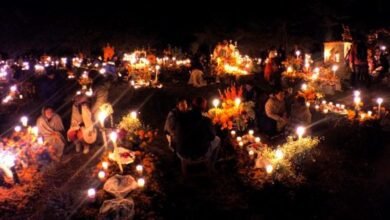
In different Purépecha communities, remembrance of deceased children is associated with the last days of October and November 1. The observances do not follow one fixed hour or uniform itinerary. The National Institute of Indigenous Peoples documents preparations for children’s altars from October 31, while accounts from the lake region reveal variations among villages and families.
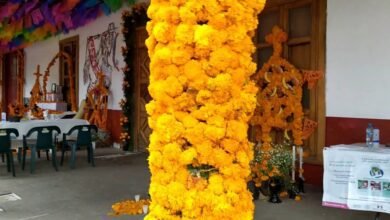
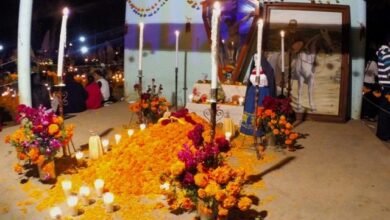
For a first offering, godparents may hold a special ceremonial responsibility. A floral arch, sweets, toys, clothes and food prepared to share express the continued bond formed during the child’s life. These are not interchangeable decorations: they are brought by people who accompany the family in mourning.
In an article published by La Voz de Michoacán on October 31, 2022, residents of Janitzio described godparents bringing arches and prayers accompanying the gathering. The chronicle records a particular practice and its timing. It is not a compulsory calendar for every subsequent year or every household.
Home and cemetery
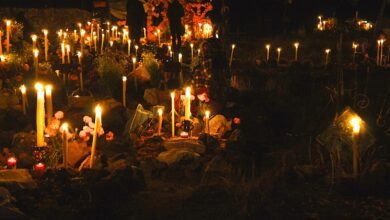
An offering may be prepared at home and later carried to the cemetery, or remain in the domestic space, depending on family and local custom. Flowers, bread, food, candles and objects associated with the child form an intimate conversation between generations. In some places prayers and shared meals gather relatives and godparents before the arch goes to the graveyard.
Accounts from different periods mention Janitzio, Huecorio and other communities as places where specific forms of observance occurred. They should not be presented as identical scenes, nor should hours recorded in old sources be turned into travel instructions for 2026. Access to burial grounds also depends on agreements and measures adopted for each edition.
The right to privacy
The beauty of a child’s offering does not make a family’s grief available to spectators. Photographing children, asking parents how a death occurred or approaching a grave without permission can intrude on the space in which the observance takes place. Above all, a guide should teach visitors to recognize when to stay away.
Vigils for children recall something essential: a community can accompany an absence without putting it on display. The arch, shared food and prayers give shape to that closeness. The tradition lives through those relationships, not through the gaze of a visitor.
Documentary sources (original titles)
- Instituto Nacional de los Pueblos Indígenas, «¿Conoces el significado de los elementos de una ofrenda de Día de Muertos?», 23 de octubre de 2019.
- La Voz de Michoacán, Angélica Ayala, «Velación de los angelitos, comunión de familias purépechas…», 31 de octubre de 2022; testimonios de familias de la región.
- Instituto Nacional de los Pueblos Indígenas, «11 altares indígenas de Día de Muertos», sección Jarácuaro.
- UNESCO, «Las fiestas indígenas dedicadas a los muertos», expediente 00054; proclamación de 2003 e inscripción de 2008.
Original Spanish titles and publication details are retained in the bibliography for accurate source identification.